


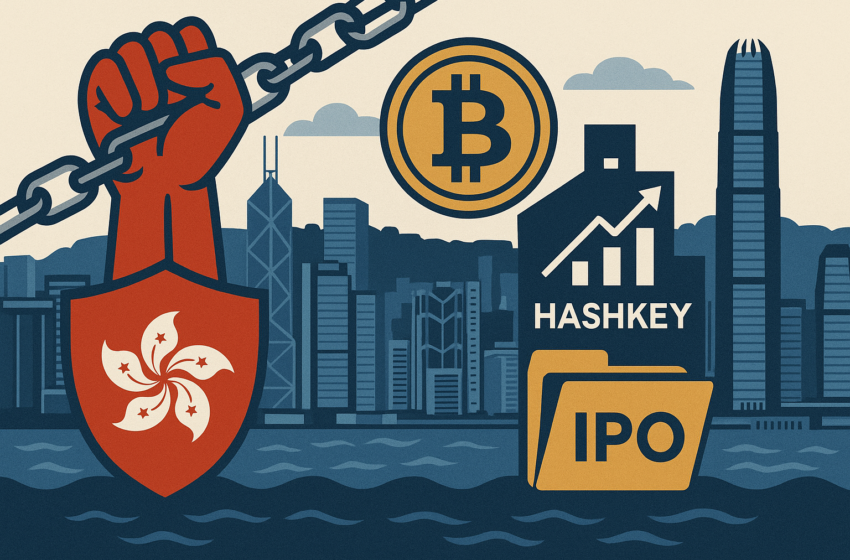
Hong Kong tightens crypto grip as HashKey clears path to IPO
(Originally posted on : CoinJournal: Latest Crypto News, Altcoin News and Cryptocurrency Comparison )
- HashKey moves closer to IPO after clearing Hong Kong listing hearing, boosting regulated crypto ambitions.
- HashKey leads Hong Kong’s licensed crypto trade but remains unprofitable despite a large client asset base.
- Firm expands globally with approvals in Dubai, Bermuda, and Ireland ahead of planned public listing.
Hong Kong’s push to build a tightly regulated digital asset market has taken another step as HashKey Holdings secures approval to move forward with an initial public offering.
The operator of the city’s largest licensed crypto exchange confirmed in a Dec. 1 disclosure that it cleared the Hong Kong Stock Exchange’s listing hearing, a milestone that positions the company to advance its plans.
The development arrives as Hong Kong continues to present itself as a controlled and legally defined alternative to the crypto restrictions on the mainland, while seeking to attract institutional and retail participation through licensed platforms.
IPO progress strengthens regulated market ambitions
HashKey has not revealed the size or timing of the IPO, but earlier reports in October indicated that the company had explored raising to $500 million.
The filing shows that JPMorgan Chase, Guotai Haitong Securities, and Guotai Junan International are acting as joint sponsors, reinforcing the city’s intention to anchor crypto activity within traditional financial structures.
Local media reported that funds raised through the offering would be directed toward technology upgrades, wider product development, stronger operational capacity, and the expansion of services into new markets.
HashKey is also prioritising the improvement of its risk management systems as part of a broader plan for long-term growth.
Licensing gives HashKey a strategic foothold
HashKey operates under the Securities and Futures Commission’s regulatory framework and was among the first digital asset companies approved to serve both institutional and retail investors under Hong Kong’s updated licensing regime.
The company holds a Type 1 licence, permitting it to deal in securities that include tokenised versions of assets categorised as securities.
It also holds a Type 7 licence, which allows it to run an automated trading platform.
Alongside this, HashKey’s asset management arm is licensed to manage portfolios consisting of up to 100 percent virtual assets.
It is one of 11 licensed virtual asset trading platforms serving retail users in Hong Kong.
This stands in contrast to mainland China, where crypto activity remains banned, highlighting Hong Kong’s continued position as a regulated gateway within the region.
Market share grows but losses persist
According to the filing, HashKey handled more than three quarters of the region’s onshore digital asset trading volume in 2024. It also held nearly HK$20 billion (US$2.56 billion) in client assets, underscoring its dominance within Hong Kong’s regulated crypto landscape.
Despite its scale, the company remains unprofitable. HashKey recorded a net loss of HK$506 million in the first half of 2025, though this represented an improvement from the HK$777 million loss logged during the same period a year earlier.
The filing noted that performance has shifted in line with market volatility, which continues to shape activity across the sector.
HashKey has been working to expand its presence through investment initiatives, including the launch of a $500 million perpetual fund focused on institutional participation in digital asset treasury projects.
The fund aims to support blockchain ecosystems such as Ethereum and seeks to contribute to long term adoption and capital movement.
Global approvals broaden HashKey’s reach
In addition to its Hong Kong operations, HashKey has extended its regulatory footprint in 2025 by securing conditional approval to operate in Dubai.
It has also obtained regulatory permissions to run licensed platforms in Bermuda and Ireland, signalling an effort to widen its global relevance ahead of its public listing.
These gains support Hong Kong’s attempt to reinforce its position as a regulated crypto centre and highlight how the city is using licensed actors to shape a defined market structure for digital assets.


 Bitcoin
  Ethereum
  Tether
  BNB
BNB  USDC
USDC  XRP
XRP  Solana
  TRON
TRON  Lido Staked Ether
  Figure Heloc
  Hyperliquid
  Dogecoin
  USDS
USDS  Rain
Rain  LEO Token
  Zcash
Zcash  Wrapped stETH
  Cardano
  Monero
  Wrapped Bitcoin
  WhiteBIT Coin
  Binance Bridged USDT (BNB Smart Chain)
  Chainlink
  Wrapped Beacon ETH
  Stellar
  Dai
Dai  Bitcoin Cash
  Wrapped eETH
  USD1
USD1  Ethena USDe
  sUSDS
sUSDS  Gram (prev. Toncoin)
  Canton
  Litecoin
  Coinbase Wrapped BTC
  Global Dollar
  Circle USYC
  Hedera
  WETH
WETH  Avalanche
  Sui
Sui  PayPal USD
  USDT0
USDT0  Shiba Inu
  BlackRock USD Institutional Digital Liquidity Fund
  Tether Gold
  Uniswap
  Cronos
  NEAR Protocol
  Ondo US Dollar Yield
  Ethena Staked USDe
  PAX Gold
  Bittensor
  OKB
OKB  Ondo
Ondo  World Liberty Financial
  HTX DAO
  Aster
Aster  Ripple USD
  USDD
USDD  MemeCore
  Little Pepe
  Falcon USD
  Wrapped BOT
  syrupUSDC
  Aave
Aave  Polkadot
  Mantle
  BFUSD
BFUSD  Sky
Sky  Morpho
  United Stables
  Pepe
Pepe  Internet Computer
  Bitget Token
  USDGO
USDGO  Worldcoin
  Ethereum Classic
  Spiko Amundi Overnight Swap Fund (EUR)
  Blockchain Capital
  Jupiter Perpetuals Liquidity Provider Token
  Pi Network
  Pump.fun
  Spiko EU T-Bills Money Market Fund
  Invesco Short Duration US Government Securities Fund
  Ethena
  Jito Staked SOL
  KuCoin
  Janus Henderson Anemoy Treasury Fund
  Kelp DAO Restaked ETH
  JUST
JUST  Quant
Quant  Binance-Peg WETH
  Stable
  Rocket Pool ETH
  POL (ex-MATIC)
  Algorand
  Binance Bridged USDC (BNB Smart Chain)
  NEXO
NEXO  Gate
Gate