


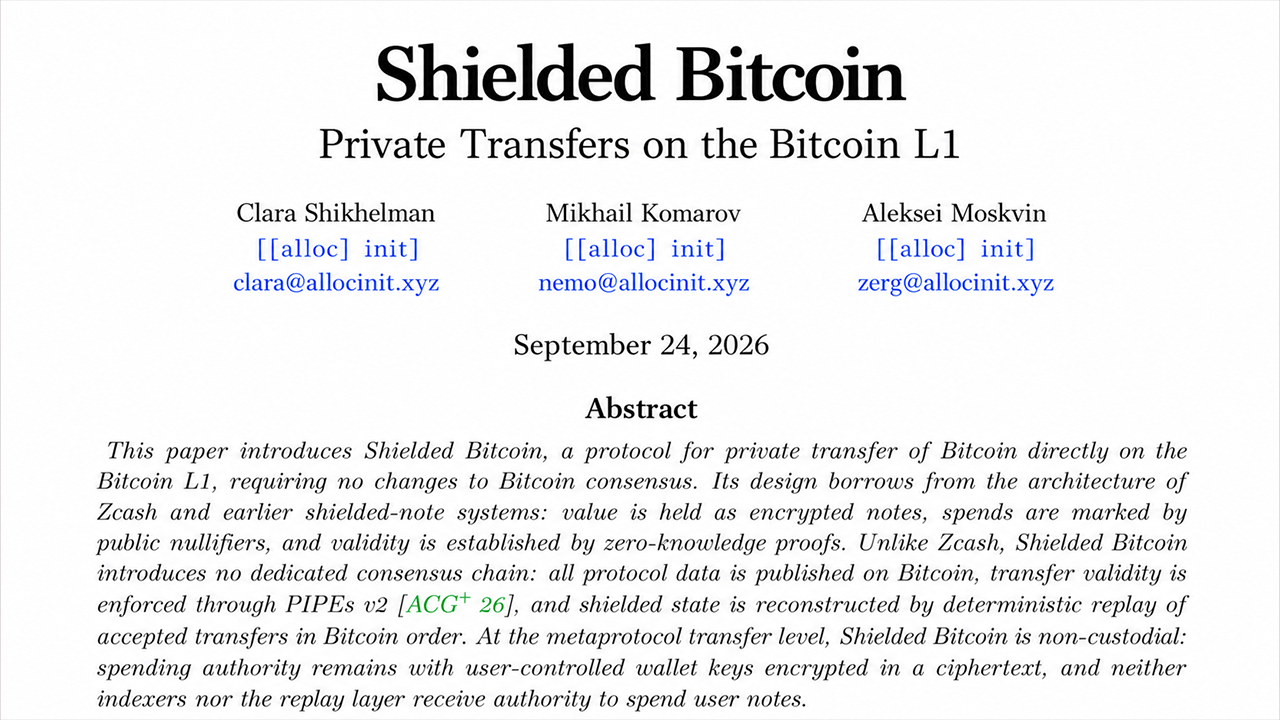
Shielded Bitcoin Proposal Aims to Bring Privacy to Bitcoin L1
Prediction Market Ethics Bill Picks Up Key Democratic Backers
(Originally posted on : Crypto News – iGaming.org )
A bipartisan group of House Democrats introduced legislation this week aimed at blocking federal officials from participating in prediction markets — a move driven by recent high-profile wagers that critics say mirror insider trading patterns seen in traditional financial markets.
Good to Know
- A bill now before Congress would bar federal officials from using nonpublic information for prediction market trades.
- The move follows scrutiny over a $400,000 payout tied to a Polymarket wager.
- Former House Speaker Nancy Pelosi, often accused of benefiting from market timing herself, is a lead sponsor.
Prediction Market Legislation Takes Shape
The Public Integrity in Financial Prediction Markets Act of 2026 was unveiled this week by Ritchie Torres of New York, with support from a group of House Democrats including Nancy Pelosi.
If enacted, the measure would bar federal elected officials, political appointees, executive branch employees, and congressional staffers from buying, selling, or otherwise trading prediction market contracts tied to government policy, government action, or political outcomes when they hold or could reasonably obtain material nonpublic information through their official roles.
Supporters say the change creates clearer ethical boundaries akin to insider-trading rules in traditional securities markets.
177% up to 5BTC + 77 Free Spins!
New players only. Exclusive Welcome Bonus of 177% + 77 Free Spins
What Sparked the Push
The effort gained traction after a widely publicized wager on the prediction platform Polymarket paid out roughly $400,000 after a trader correctly bet on Venezuelan President Nicolás Maduro’s ouster. Critics raised questions about whether that trade was timed with privileged insight into imminent U.S. actions — and whether federal officials with access to similar inside information could exploit prediction markets before the public.
Torres said the intersection of government service and prediction market bets poses “demonstrated dangers” and could erode trust if left unchecked.
Backers and Platform Voices
Not all market operators view the bill the same way, but some have been vocal. Kalshi CEO Tarek Mansour has publicly voiced support for the legislation, pointing out that his platform already enforces insider-trading prohibitions, while other markets lack strict safeguards.
Proponents, including U.S. Senator Chris Murphy, argue Washington insiders should not be able to trade on information that is not publicly available — a principle borrowed from longstanding rules in securities law.
Get 125% / $2,500 on 1st deposit!
New players only. Exclusive Welcome Bonus of up to $2,500
Pelosi’s Role and Public Perception
It’s especially interesting that Nancy Pelosi is a lead sponsor of this bill, given the long-running public debate over her own financial activity. Critics often dispute how Pelosi and her family have generated substantial trading profits — sometimes hundreds of millions — while serving in Congress, especially given that members of Congress earn only their government salaries.
Pelosi’s investment record has drawn ongoing scrutiny. For decades, she and her husband have reported significant gains from stock trades and portfolio growth, with estimates of at least tens of millions in profits over her career. Those gains have led to calls for broader restrictions on trading by lawmakers, including proposals like the PELOSI Act aimed at limiting members of Congress and their families from profiting from market moves potentially tied to information not yet available to the public.
Pelosi has denied involvement in individual trades, and her office says her husband conducts investment decisions independently. Still, her public image on market practices remains a focal point in the broader debate about ethical constraints for policymakers.
Worries and Critique
Opponents of the restrictions worry that overly broad limits could chill beneficial information flows or deter useful signals that prediction markets can provide. But lawmakers pushing the bill argue that when federal officials profit from outcomes tied to political developments or policy decisions, public trust suffers.
Policymakers on both sides of the aisle have wrestled with how to balance innovation in financial technology with traditional ethical boundaries, and this legislation is seen as a first step in addressing gaps in current oversight.



 Bitcoin
  Ethereum
  Tether
  BNB
BNB  XRP
XRP  USDC
USDC  Solana
  TRON
TRON  Lido Staked Ether
  Zcash
Zcash  Figure Heloc
  Hyperliquid
  Dogecoin
  Monero
  Chainlink
  WhiteBIT Coin
  Wrapped stETH
  USDS
USDS  Wrapped Bitcoin
  Cardano
  Rain
Rain  Binance Bridged USDT (BNB Smart Chain)
  LEO Token
  Wrapped Beacon ETH
  Stellar
  Bitcoin Cash
  NEAR Protocol
  Wrapped eETH
  Uniswap
  sUSDS
sUSDS  Litecoin
  Ethena USDe
  Canton
  Dai
Dai  Coinbase Wrapped BTC
  Avalanche
  USD1
USD1  Sui
Sui  WETH
WETH  Hedera
  Gram (prev. Toncoin)
  Shiba Inu
  USDT0
USDT0  Bittensor
  Global Dollar
  Cronos
  MemeCore
  PayPal USD
  Tether Gold
  Ondo
Ondo  Ethena Staked USDe
  Bitway
  OKB
OKB  Circle USYC
  Ripple USD
  BlackRock USD Institutional Digital Liquidity Fund
  Ondo US Dollar Yield
  Ethena
  Aave
Aave  Mantle
  Morpho
  Little Pepe
  Wrapped BOT
  syrupUSDC
  Polkadot
  Aster
Aster  PAX Gold
  Pepe
Pepe  Pump.fun
  World Liberty Financial
  Internet Computer
  Sky
Sky  Worldcoin
  HTX DAO
  USDD
USDD  Ethereum Classic
  Arbitrum
  Venice Token
  Spiko Amundi Overnight Swap Fund (EUR)
  United Stables
  Jupiter Perpetuals Liquidity Provider Token
  USDGO
USDGO  Bitget Token
  Quant
Quant  Falcon USD
  BFUSD
BFUSD  Jito Staked SOL
  Lighter
  POL (ex-MATIC)
  Kelp DAO Restaked ETH
  Gate
Gate  Kaspa
Kaspa  Binance-Peg WETH
  Rocket Pool ETH
  Algorand
  Jupiter
  KuCoin
  Binance Bridged USDC (BNB Smart Chain)
  Blockchain Capital
  Pi Network