


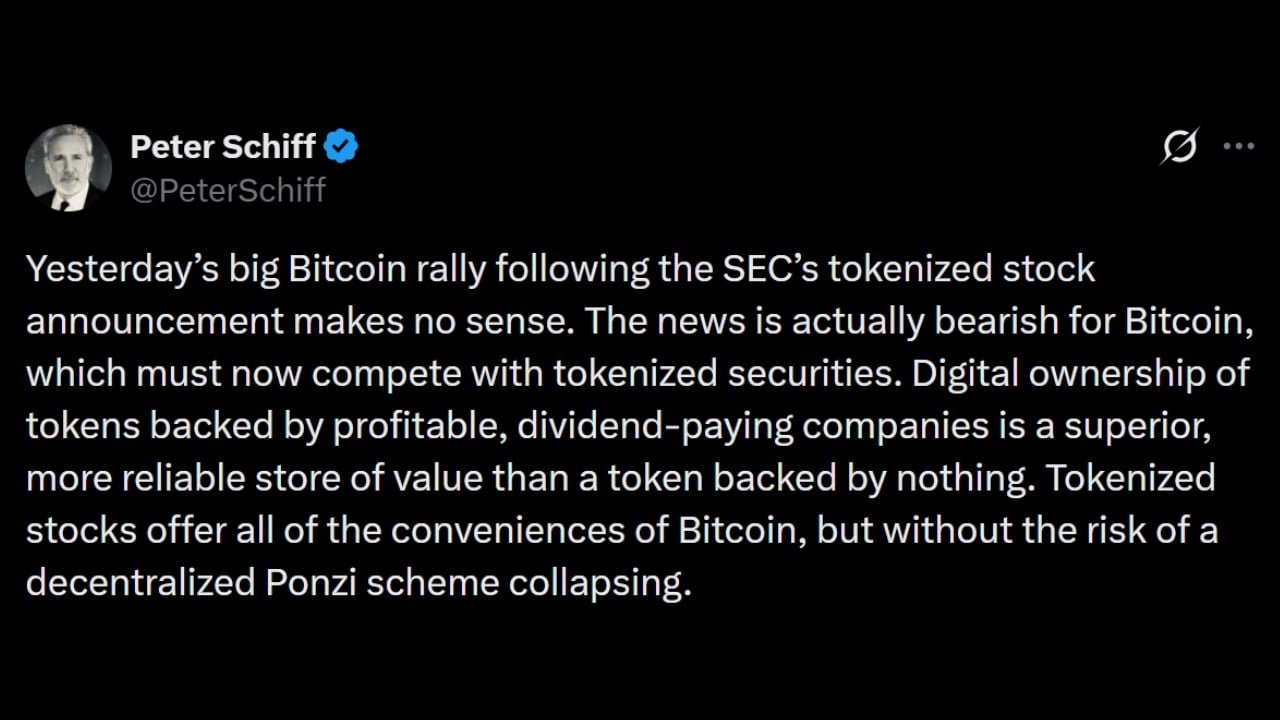
Schiff Warns Tokenized Stocks Will Siphon Liquidity From Bitcoin

Strategy Founder Says Bitcoin Volatility Reflects Adoption Cycle
(Originally posted on : Crypto News – iGaming.org )
Michael Saylor, founder of Strategy and creator of the 21 rules of Bitcoin, addressed criticism around bitcoin performance during a recent interview, arguing that market pullbacks reflect adoption cycles rather than weakness in the asset. He pointed to historical patterns in technology markets and outlined how infrastructure gaps in traditional finance continue to shape price behavior.
Good to Know
- Saylor compared the recent bitcoin drawdown of about 45 percent to declines seen in major technology stocks during early growth phases.
- Large banks may need four to six years to fully integrate bitcoin into custody, lending, and credit frameworks.
- Strategy is developing structured products designed to reduce volatility exposure while still linking returns to bitcoin performance.
Speaking with Natalie Brunell on Coin Stories, Saylor described the period since the last market peak, now more than 137 days, as a routine phase in adoption cycles for disruptive technology. Market hesitation, in his view, mirrors reactions seen during earlier waves of innovation such as cloud computing or smartphones.
He pointed to recovery experienced by Apple after a comparable decline between 2012 and 2013, noting that markets often discount emerging technology before repricing long term value. Bitcoin, he argued, remains in a similar stage where conviction among early adopters runs ahead of infrastructure built by conventional finance.
“You have a situation where the banking establishment is embracing bitcoin at a progressive, but a slower rate than people with short attention spans would like,” Saylor told Brunell. “It’ll take the banks four years, five years, six years before they embrace an entirely new asset class. People would like for bitcoin to be recognized in four months,” he added.
Get 125% / $2,500 on 1st deposit!
New players only. Exclusive Welcome Bonus of up to $2,500
Limited integration into credit markets creates tangible constraints. Traditional equities can be pledged easily for low cost borrowing, while many bitcoin holders still face higher financing costs or restricted access to loans. Offshore arrangements sometimes allow collateral to be reused multiple times, a practice that can add selling pressure.
“I think what holds down the price of the asset is the lack of a fully formed non-rehypothecating credit system.”
Why Volatility Remains Central to the Bitcoin Case
Price swings often attract criticism, yet Saylor framed volatility as a functional characteristic of a global asset trading nonstop. Continuous trading hours allow capital flows during weekends and overnight sessions, periods when traditional markets remain closed.
Such constant liquidity creates conditions where traders engage precisely because movement exists across time zones. Long horizon investors, he suggested, should interpret periodic drawdowns as part of a multi cycle expansion tied to broader monetization.
Get 125% / $2,500 on 1st deposit!
New players only. Exclusive Welcome Bonus of up to $2,500
Saylor projected roughly 29 percent annual returns across a 21 year timeframe, while acknowledging that performance may arrive unevenly rather than in a straight trajectory.
Strategy Experiments With Financial Structures Linked to Bitcoin
Beyond macro commentary, Strategy continues building instruments aimed at widening investor participation. Preferred equity offerings seek to separate yield generation from raw price movement, a model Saylor described as “volatility engineering.”
Products under development attempt to channel predictable income characteristics familiar to bond investors while maintaining exposure to bitcoin driven growth. Many retail participants, according to Saylor, favor stable double digit returns paired with tax efficiency rather than assets associated with sharp interim declines.
Quantum Computing Concerns Addressed With Long Term View
Saylor also responded to fears that advances in quantum computing could threaten cryptographic security. Industry consensus, he said, places any material risk more than a decade away, giving networks time to adapt.
“Consensus of the cyber security community broadly held is that quantum risk, if it exists, is more than ten years out. It’s not a this-decade thing.”
“Should a quantum risk materialize at that point then you’re going to see an upgrade in the software that runs the global banking system, the global internet, consumer devices, all the crypto networks, the Bitcoin network — everything digital — they’re going to get upgraded with post-quantum resistant cryptography.”
350% or 5BTC + 150 Spins!
New players only. Exclusive Welcome Bonus of 350% + 150 Free Spins
At time of writing Bitcoin is trading at $63,186, down 7.6% over the last week.



 Bitcoin
  Ethereum
  Tether
  BNB
BNB  XRP
XRP  USDC
USDC  Solana
  TRON
TRON  Lido Staked Ether
  Zcash
Zcash  Figure Heloc
  Hyperliquid
  Dogecoin
  Monero
  WhiteBIT Coin
  USDS
USDS  Wrapped stETH
  Rain
Rain  Chainlink
  Wrapped Bitcoin
  Cardano
  Binance Bridged USDT (BNB Smart Chain)
  LEO Token
  Wrapped Beacon ETH
  Stellar
  Uniswap
  Bitcoin Cash
  Wrapped eETH
  Ethena USDe
  sUSDS
sUSDS  NEAR Protocol
  Dai
Dai  Litecoin
  USD1
USD1  Coinbase Wrapped BTC
  Avalanche
  Canton
  Gram (prev. Toncoin)
  WETH
WETH  Hedera
  Sui
Sui  MemeCore
  USDT0
USDT0  Global Dollar
  Shiba Inu
  Cronos
  Bittensor
  PayPal USD
  Tether Gold
  Circle USYC
  Ethena Staked USDe
  OKB
OKB  Ripple USD
  BlackRock USD Institutional Digital Liquidity Fund
  Ondo US Dollar Yield
  Aave
Aave  Ethena
  Ondo
Ondo  Aster
Aster  Mantle
  PAX Gold
  Little Pepe
  Wrapped BOT
  syrupUSDC
  Pump.fun
  Bitway
  Polkadot
  World Liberty Financial
  Morpho
  Pepe
Pepe  Sky
Sky  Internet Computer
  HTX DAO
  USDD
USDD  Worldcoin
  Arbitrum
  Spiko Amundi Overnight Swap Fund (EUR)
  Bitget Token
  United Stables
  USDGO
USDGO  Jupiter Perpetuals Liquidity Provider Token
  Akedo
Akedo  Falcon USD
  Venice Token
  BFUSD
BFUSD  Ethereum Classic
  Jito Staked SOL
  Lighter
  POL (ex-MATIC)
  Kelp DAO Restaked ETH
  Gate
Gate  Kaspa
Kaspa  Binance-Peg WETH
  Rocket Pool ETH
  KuCoin
  Blockchain Capital
  Pi Network
  Binance Bridged USDC (BNB Smart Chain)
  JUST
JUST  Quant
Quant