


EU Parliament Clears Path for Key Interinstitutional Negotiations

Vitalik Warns Ethereum’s Smart Wallets Have a ‘Relay’ Problem Ahead of Major Upgrade
(Originally posted on : Bitcoin News )
Key Takeaways
- Vitalik Buterin flagged ‘relay dependence’ on X as a fragility concern for Ethereum’s smart wallet users.
- FOCIL and EIP-8141 are targeted for the Hegota upgrade in late 2026 to rebuild the public mempool.
- EIP-7701 enables native account abstraction for Ethereum wallets, expected with the Hegota fork.
The Problem With Relays
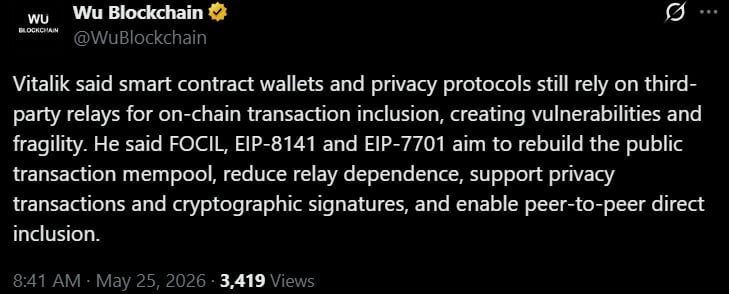
Smart contract wallets (i.e. crypto accounts controlled by programmable code instead of a standard private key) are becoming increasingly prominent across the Ethereum landscape because they enable multi-signature security, social recovery, and gas sponsorship. Privacy protocols, which obscure transaction details from public view, face a similar constraint because, much like smart contract wallets, they currently depend on third-party relay services to get transactions included onchain.
Buterin has described this relay dependency as a source of vulnerability and fragility, since if a relay goes offline or if a relay operator refuses to process a specific transaction, the end user has no alternative path to inclusion.
These centralized chokepoints run counter to Ethereum’s foundational principle of censorship resistance, one of the two priorities Buterin has named as central to the Ethereum Foundation’s narrowed technical mission going forward.
FOCIL and EIP-8141 Aim to Remove the Relay Bottleneck
The solution Buterin outlined involves two Ethereum Improvement Proposals (EIPs), the standard mechanism through which protocol changes are specified and debated, working alongside a new inclusion mechanism called FOCIL (Fork-choice Enforced Inclusion List).
FOCIL was officially scheduled for inclusion in the upcoming Hegota upgrade targeting late 2026, introducing a mechanism that randomly selects validators to act as transaction “includers” for each block slot.
That randomness makes it structurally difficult for any actor to censor a transaction by simply refusing to relay it, because no single party controls which validator handles inclusion. The design targets a one-to-two slot transaction inclusion guarantee, meaning valid transactions should find their way into the blockchain within two block intervals.
- EIP-7701 introduces native account abstraction, a change that would give every Ethereum wallet the programmability currently reserved for smart contract accounts.
- EIP-8141 builds directly on EIP-7701 and further extends account abstraction, enabling features such as quantum-resistant signatures, key rotation, and gas sponsorship at the base protocol level.
Under the combined FOCIL and EIP-8141 design, a smart contract wallet would submit transactions directly to the public memory pool (commonly referred to as the mempool), where a randomly selected FOCIL includer would pick them up. No wrappers. No intermediary broadcasters. No relay required at any stage.
Looking ahead, Buterin has stated that privacy and censorship resistance will be two technical priorities for the Ethereum Foundation, with Bitcoin.com News having reported on those strategic shifts last week.
The Hegota upgrade is expected to represent one of the most high-profile consensus-layer changes in Ethereum’s nearly decade-old history, especially since its transition to a proof-of- stake framework back in 2022.


 Bitcoin
  Ethereum
  Tether
  BNB
BNB  USDC
USDC  XRP
XRP  Solana
  TRON
TRON  Figure Heloc
  Lido Staked Ether
  Hyperliquid
  Dogecoin
  USDS
USDS  Rain
Rain  LEO Token
  Zcash
Zcash  Wrapped stETH
  WhiteBIT Coin
  Stellar
  Wrapped Bitcoin
  Cardano
  Binance Bridged USDT (BNB Smart Chain)
  Monero
  Wrapped Beacon ETH
  Chainlink
  Canton
  Bitcoin Cash
  Wrapped eETH
  Dai
Dai  sUSDS
sUSDS  Gram (prev. Toncoin)
  USD1
USD1  Ethena USDe
  Litecoin
  Coinbase Wrapped BTC
  Global Dollar
  Circle USYC
  Hedera
  WETH
WETH  Sui
Sui  Avalanche
  BlackRock USD Institutional Digital Liquidity Fund
  USDT0
USDT0  PayPal USD
  Shiba Inu
  Cronos
  Tether Gold
  NEAR Protocol
  Uniswap
  Ondo US Dollar Yield
  Ethena Staked USDe
  Bittensor
  World Liberty Financial
  PAX Gold
  MemeCore
  OKB
OKB  Aster
Aster  HTX DAO
  DeXe
DeXe  Ondo
Ondo  USDD
USDD  Little Pepe
  Ripple USD
  syrupUSDC
  Polkadot
  Aave
Aave  Morpho
  Falcon USD
  Mantle
  Sky
Sky  Worldcoin
  BFUSD
BFUSD  Internet Computer
  Pepe
Pepe  Bitget Token
  Ethereum Classic
  Pi Network
  United Stables
  Spiko EU T-Bills Money Market Fund
  Jupiter Perpetuals Liquidity Provider Token
  Quant
Quant  Blockchain Capital
  KuCoin
  USDGO
USDGO  JUST
JUST  Jito Staked SOL
  Janus Henderson Anemoy Treasury Fund
  Stable
  Kelp DAO Restaked ETH
  POL (ex-MATIC)
  Audiera
  Binance-Peg WETH
  Cosmos Hub
  Rocket Pool ETH
  Kaspa
Kaspa  Render
  Binance Bridged USDC (BNB Smart Chain)
  ADI
ADI  Invesco Short Duration US Government Securities Fund
  Wrapped BNB