
Securitize Integrates With TRON to Bring Tokenized Real-World Assets to

World Liberty Financial Borrows Millions on Dolomite, Defends WLFI Collateral – Defi Bitcoin News
(Originally posted on : Bitcoin News )
Key Takeaways:
- World Liberty Financial borrowed millions in stablecoins on Dolomite using 5 billion WLFI tokens as collateral in April 2026.
- DeFi analysts warn Dolomite’s USD1 pool faces bad debt risk, with WLFI collateral exceeding 50% of the protocol’s $836 million TVL.
- WLFI plans a governance vote next week to unlock tokens for early holders, with 80% of presale supply still locked.
- WLFI critiques have been going viral on social media. World Liberty Financial addressed the critics in a thread on X.
WLFI Governance Token Drops 10% as DeFi Community Questions Dolomite Borrowing Strategy
The Trump family-backed DeFi project supplied approximately 5 billion WLFI governance tokens, nominally valued between $440 million and $460 million, as collateral to borrow roughly $65.4 million in USD1 and $10.3 million in USDC. Onchain data shows that more than $40 million of those borrowed funds were subsequently moved to Coinbase Prime. Observers offered a decidedly cool reception.
WLFI launched World Liberty Markets in January 2026 as a lending and borrowing interface built directly on Dolomite. Dolomite co-founder Corey Caplan serves as an advisor and reported chief technology officer to WLFI. Arkham’s onchain records show WLFI’s treasury multisig routed the collateral across multiple wallets, including an intermediary address and a Gnosis Safe that transferred approximately 3 billion WLFI tokens to Dolomite in early April.
Earlier deposits included roughly 1.99 billion WLFI tokens. The position now represents more than half of Dolomite’s total supplied assets, which sit at an estimated $825 million to $836 million in total value locked. On April 9, 2026, WLFI’s official account on X published a thread addressing what it called community “FUD.” The project stated it was nowhere near liquidation and argued that its role as the anchor borrower was generating yield that made the protocol attractive for all depositors.
“By being the anchor borrower, we’re generating the yield that makes WLFI Markets compelling for everyone else,” the statement read. The team added:
“Everyday users are earning outsized stablecoin yields right now.”
DeFi analysts on X pointed to several structural concerns. WLFI trades with thin market depth relative to the size of the position, meaning a price decline toward liquidation thresholds could trigger forced sales that would further depress the token and prevent a clean unwind. Critics compared the setup to past DeFi events involving CRV and Wonderland, where illiquid collateral led to bad debt that depositors could not recover.
The USD1 pool on Dolomite reported utilization rates near 93%, with supply rates spiking as high as 35% in earlier related activity. High utilization leaves limited liquidity for depositors who want to exit the pool before the large borrower repays.
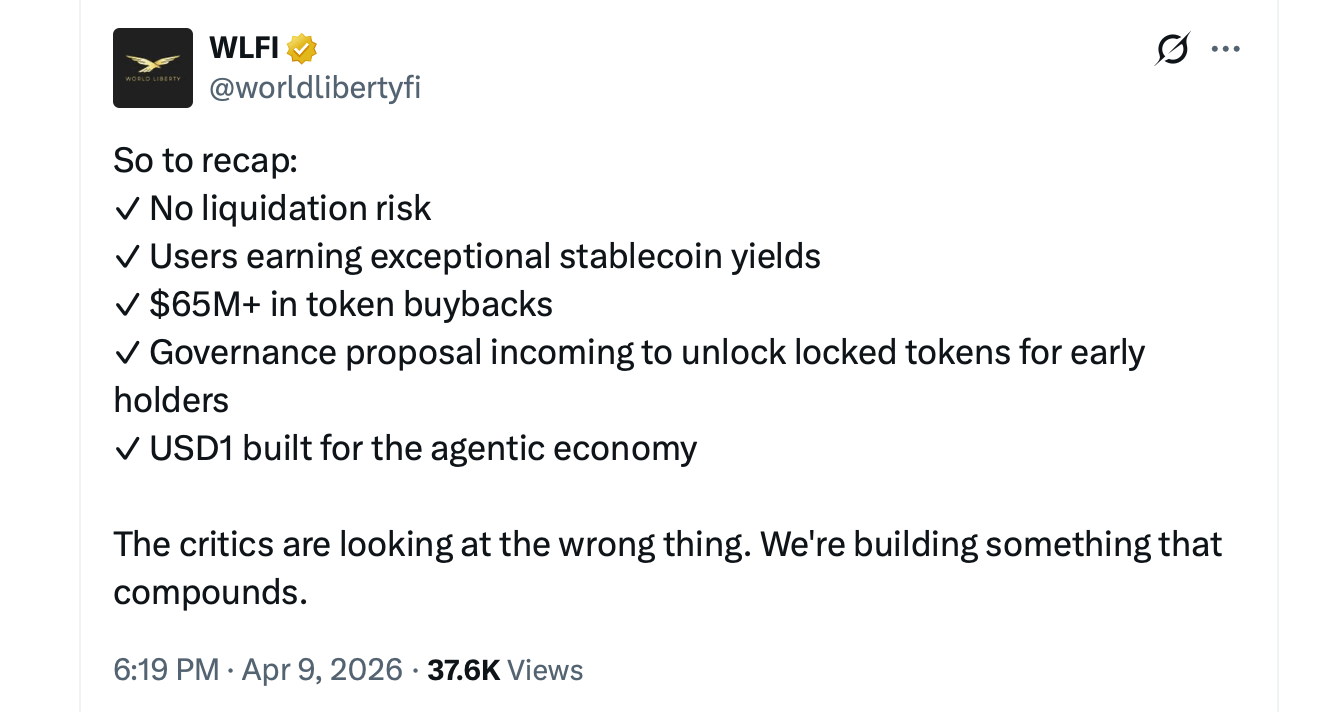
WLFI’s response framed the arrangement as strategic. The project said it had repurchased more than 435 million WLFI tokens at an average price of approximately $0.1507, totaling roughly $65.6 million in open-market buybacks over the past six months. USD1 circulation now exceeds $4 billion backed by U.S. Treasuries and cash equivalents, which WLFI cited as evidence of a $159.5 million annualized revenue run rate.
The project also said a governance proposal would be posted to its forum within the week, followed by a community vote to unlock tokens for early holders. Approximately 80% of presale WLFI tokens remain locked, a point that drew repeated responses from community members in WLFI’s thread and in other posts.
The WLFI governance token fell roughly 8-10% to a record low following coverage of the Dolomite position. Over a rolling seven-day window, losses reached approximately 14%. No liquidation has occurred as of April 10, 2026, and the project says the position remains overcollateralized.
Separately, WLFI noted upgrades to USD1 that include gasless transfers and features designed for AI agents, signaling continued product development alongside the treasury activity. The latest episode reflects a recurring tension in DeFi between governance token leverage, protocol concentration, and aligned incentives in projects where the protocol builder, token issuer, and borrower are closely connected.

 Bitcoin
  Ethereum
  Tether
  XRP
XRP  BNB
BNB  USDC
USDC  Solana
  TRON
TRON  Figure Heloc
  Lido Staked Ether
  Dogecoin
  USDS
USDS  WhiteBIT Coin
  Hyperliquid
  Cardano
  LEO Token
  Wrapped stETH
  Bitcoin Cash
  Chainlink
  Wrapped Bitcoin
  Monero
  Binance Bridged USDT (BNB Smart Chain)
  Zcash
Zcash  Wrapped Beacon ETH
  Ethena USDe
  Canton
  Stellar
  Wrapped eETH
  MemeCore
  Dai
Dai  sUSDS
sUSDS  Litecoin
  USD1
USD1  Avalanche
  Coinbase Wrapped BTC
  PayPal USD
  Rain
Rain  Hedera
  WETH
WETH  Sui
Sui  Shiba Inu
  Toncoin
  USDT0
USDT0  Cronos
  Circle USYC
  Tether Gold
  Bittensor
  World Liberty Financial
  PAX Gold
  BlackRock USD Institutional Digital Liquidity Fund
  Ethena Staked USDe
  Mantle
  Polkadot
  Global Dollar
  Uniswap
  Sky
Sky  Falcon USD
  OKB
OKB  NEAR Protocol
  Pi Network
  Aster
Aster  Little Pepe
  syrupUSDC
  HTX DAO
  USDD
USDD  Pepe
Pepe  Aave
Aave  Internet Computer
  Ripple USD
  Bitget Token
  Janus Henderson Anemoy Treasury Fund
  Ondo US Dollar Yield
  Ethereum Classic
  BFUSD
BFUSD  Ondo
Ondo  KuCoin
  Gate
Gate  Quant
Quant  Pump.fun
  Jupiter Perpetuals Liquidity Provider Token
  Render
  Morpho
  Algorand
  Spiko EU T-Bills Money Market Fund
  Cosmos Hub
  Jito Staked SOL
  Kaspa
Kaspa  POL (ex-MATIC)
  Kelp DAO Restaked ETH
  Worldcoin
  NEXO
NEXO  Binance-Peg WETH
  USDtb
USDtb  Rocket Pool ETH
  Ethena
  Superstate Short Duration U.S. Government Securities Fund (USTB)
  Binance Bridged USDC (BNB Smart Chain)
  Blockchain Capital
  Filecoin
  Wrapped BNB