

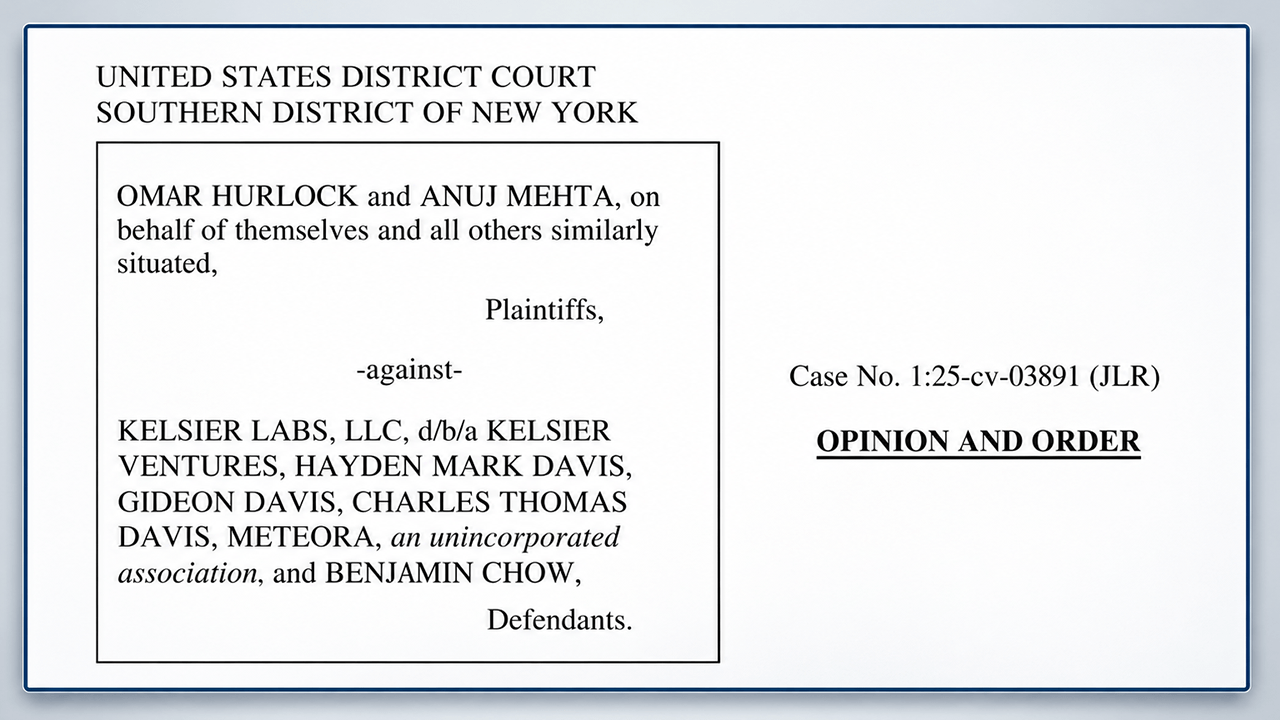
US Judge Dismisses Libra Crypto Class Action Against Kelsier

A Winning Strategy: Buy High, Sell Low
(Originally posted on : Bitcoin News )
As of early Friday morning, Bitcoin has held steady this week, moving in a band between $61,500 and $64,000. Ditto for equities. Both Bitcoin and equities reacted negatively to the intensified US-Iran conflict and spiking oil, but recovered on Thursday.
The macro story of the week comes from the East. The weakening yen has pushed Japanese bankruptcies to record levels, and Japan’s 10-year yield jumped to 2.83%, its highest in almost 30 years. Roberto Rios believes that Japan is the linchpin of the global bond market, and that when it withdraws its liquidity bid from every sovereign debt market to save its currency, the world will tremble. An account claiming to be a Bank of Japan insider apologized to the Western world in advance for the measures the Bank of Japan is preparing.
Meanwhile the dollar keeps confounding its obituary writers. Robin Brooks showed that there never was a “Sell America” trade: Foreign investors have never bought more U.S. assets than they are buying right now. Brad Setser calls it the age of the profit dollar, in which foreigners pile into U.S. equities to chase returns, not safety, with the dollar’s share of global equity indexes now exceeding its share of official FX reserves. All of this is happening as Treasury Secretary Scott Bessent makes explicit that America is changing the rules of trade in its favor, and the days of being played are over. This has been made clear since the beginning of Donald Trump’s second presidency, but somehow needs to be reiterated over and over again.
Mr Bessent’s counterpart, Fed Chair Kevin Warsh, announced his new task force leaders. So far the announcement has been met with approval, even those usually critical of the Federal Reserve.
In the digital assets realm, Strategy refused to cede the spotlight, this time by selling 3,588 BTC for $216 million to further fund preferred dividends. OG X poster Light was right when he said last week Strategy was selling. It is the largest Bitcoin disposal in Strategy’s history, and it was executed at an average price around $60,000 against a cost basis north of $75,000. Buy high, sell low.
This is not quite a joke. Michael Kao believes Mr. Saylor has introduced a permanent “negative gamma” fixture into the ecosystem, one that forces buy-high/sell-low behavior at scale: Issue paper and buy BTC when things are euphoric, sell BTC to service the paper when things are ugly. Some within crypto have echoed skepticism of Strategy’s long-term ability to flourish, such as Tarun Chitra on a recent episode of the Chopping Block podcast where he called Strategy’s STRC Luna for suits.
In other Bitcoin-related news. BTC touched the 200-week moving average, which PlanB notes has historically been the best zone for long-term buys. Your weekly hopium. Tether is bringing USDT natively back to the Bitcoin network through the RGB protocol, Eric Trump celebrated American Bitcoin crossing the 8,000 BTC mark while mining at a 52% profit margin in Q1. Bloomberg reports the Strategic Bitcoin Reserve is facing hurdles as two government departments fight over who gets to run it.
In privacy, Zcash’s new Ironwood pool is being formally verified to rule out undetectable counterfeiting bugs. Mert, an admitted diehard, thinks this is colossal. It makes undetectable counterfeit bugs in Zcash mathematically impossible going forward, solving the biggest tradeoff in private money. Mathematically impossible, that is, if the formal verification is set up correctly.
In memecoins, ANSEM continues to captivate. The market cap of ANSEM has flipped $TRUMP, a fact trumpeted (pun intended) by ANSEM supporters, but one not particularly surprising considering that over time 99.99% of memecoins trend to zero. Regardless, ANSEM commands attention now. Afroman is asking Ansem to send him some coins in exchange for a song and music video. DonAlt, meanwhile, offered the hot take that if he were a bad actor, he’d have someone launch a coin for him, take it over to “save the community,” then airdrop a chunk of supply to friends and influencers so they stay quiet when it goes to shit.
Suspicion of KOLs is understandable.There are vanishingly few who remain net positive over time. This week a crypto KOL admitted to a crime on stream for attention. It sure feels like they don’t make them like they used to.
The Venice token-equity debate continued unabated through last weekend thanks to Haseeb Qureshi, who led the deal at Dragonfly, releasing a video that explained why they invested and what he thinks VVV actually is. Venice also has a real competitor now called Wisp, which was built by the Lido team to solve their own internal privacy problem.
The Venice crypto community calmed down this week, something the company is probably happy about and will give them some breathing room to think about their next moves as it relates to VVV. Meanwhile Grass, a DePin project that rewards users for sharing unused internet bandwidth, angered its community. Grass, which like Venice had largely cultivated nothing but good will with its community up to now, announced its rewards Stage 2 with a switch from native tokens to USDC and paltry payouts. They might be about to lose much of their community bandwidth. It really is hard to make the right decisions.
One company consistently making the right moves is Robinhood. Robinhood Chain got off to a scorching start. Hayden Adams gushed that the chain did $500 million in 24-hour volume on Uniswap, 10x the day before and more than any chain other than Ethereum mainnet. Their first week numbers are incredible. One thing to watch is that most of the DEX volume is from memes, a common occurrence when a new chain launches because speculators see opportunity on fresh chains with no existing memecoins. So it remains to be seen if the trading volume will be sustainable over time.
Vlad Tenev thinks the future of crypto is in real-world assets, which means he probably thinks its Robinhood Chains future too, but he also likes the memes too. As mentioned last week, exchanges (and chains) love memecoins due to the trading volume. Speaking of RWAs, Tron’s TVL is up $1.95 billion since July 1, a clean uptrend that Mr. Tenev has to hope his blockchain will match or exceed.
Based on the initial success of the Robinhood chain, Travis Kling raised an excellent question: Isn’t it now obvious that real companies doing real things have no interest in existing public chains? Mike Dudas supplied some supporting evidence: Sui does 6 million TPS and $1,000 of daily revenue, a high-performance ghost chain trading at a $7.2 billion FDV.
As pointed out by Graham Stone on this week’s episode of Token Narratives, the Robinhood chain is bullish for Ethereum since it demonstrates how easy it is to spin up an Ethereum L2 you control, but still doesn’t explain why ETH the asset should accrue value. Indeed, ETH is getting outperformed by coffee. TXMC asked a question no one wants to contemplate: What if ETH/BTC simply does what LTC/BTC did?
Blockworks CEO Jason Yanowitz thinks we might be living through crypto’s post-2000 internet bubble moment, pointing to Fred Wilson’s classic essay on what bear markets look like. Retail is gone, investors are gone, and even devs are moving on from what they feel is a broken industry. That was also the moment, it’s worth remembering, when the internet as we know it today got built.
Which may be why the smart institutional money keeps pouring into crypto, not out. Vanguard, the $10-plus trillion asset manager and tradfi’s last great crypto holdout, posted a job listing for its first-ever Head of Digital Assets, Incredibly bullish institutional news! Well, almost. Vanguard reached out to Eric Balchunas to clarify that they haven’t “bent the knee” or been orange pilled; they just want to make sure they’re utilizing the tech. Sure, Vanguard. That’s how it starts. Someone needs to make a Polymarket on whether Vanguard will announce direct crypto offerings within six months!
-David Sencil


 Bitcoin
  Ethereum
  Tether
  BNB
BNB  XRP
XRP  USDC
USDC  Solana
  TRON
TRON  Lido Staked Ether
  Figure Heloc
  Zcash
Zcash  Hyperliquid
  Dogecoin
  Chainlink
  Monero
  Wrapped stETH
  WhiteBIT Coin
  USDS
USDS  Wrapped Bitcoin
  Cardano
  Rain
Rain  Binance Bridged USDT (BNB Smart Chain)
  LEO Token
  Wrapped Beacon ETH
  Stellar
  NEAR Protocol
  Bitcoin Cash
  Wrapped eETH
  Uniswap
  sUSDS
sUSDS  Litecoin
  Ethena USDe
  Avalanche
  Sui
Sui  Coinbase Wrapped BTC
  Canton
  Hedera
  Blockchain USD
  Dai
Dai  WETH
WETH  USD1
USD1  Gram (prev. Toncoin)
  Bitway
  USDT0
USDT0  Bittensor
  Shiba Inu
  Cronos
  Tether Gold
  Quant
Quant  Global Dollar
  PayPal USD
  Ethena Staked USDe
  Aave
Aave  Pump.fun
  OKB
OKB  Ripple USD
  Ethena
  Ondo
Ondo  MemeCore
  Circle USYC
  Ondo US Dollar Yield
  Little Pepe
  BlackRock USD Institutional Digital Liquidity Fund
  Wrapped BOT
  syrupUSDC
  Mantle
  Polkadot
  Aster
Aster  Worldcoin
  Sky
Sky  Pepe
Pepe  Internet Computer
  Morpho
  PAX Gold
  World Liberty Financial
  HTX DAO
  USDD
USDD  United Stables
  Spiko Amundi Overnight Swap Fund (EUR)
  Falcon USD
  Ethereum Classic
  Jupiter Perpetuals Liquidity Provider Token
  Bitget Token
  Arbitrum
  Venice Token
  BFUSD
BFUSD  Algorand
  Jito Staked SOL
  USDGO
USDGO  Gate
Gate  Kelp DAO Restaked ETH
  POL (ex-MATIC)
  Kaspa
Kaspa  Binance-Peg WETH
  Rocket Pool ETH
  Jupiter
  JUST
JUST  KuCoin
  Binance Bridged USDC (BNB Smart Chain)
  Render