


Bitcoin Early Adopters Stir as 6,427 BTC Worth $500M Moves in August
(Originally posted on : Bitcoin News )
Key Takeaways
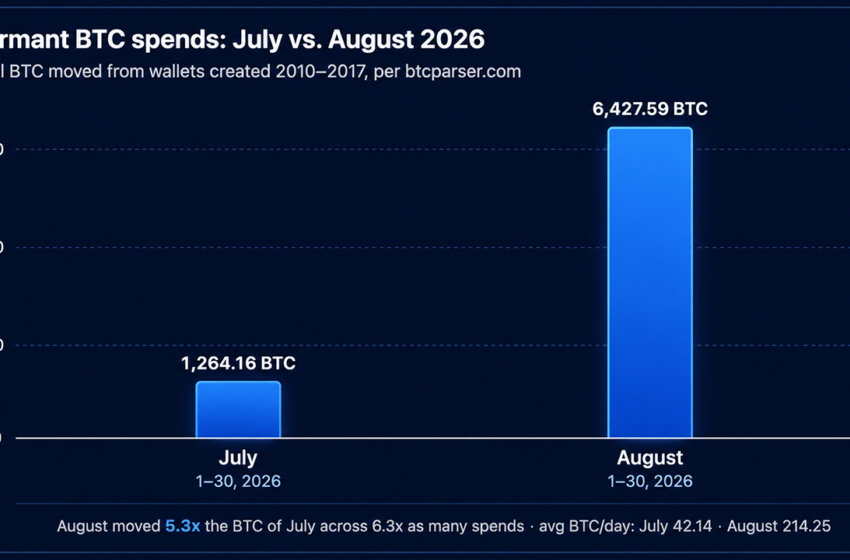
- The Bitcoin blockchain saw 6,427.59 dormant BTC worth $507M move across 188 spends between Aug. 1-30, 2026.
- Coldcard losses reached roughly 2,000 BTC as vintage Bitcoin wallets stirred.
- Bitcoin’s 2014 cohort moved 3,286.26 BTC, with 22 wallets swept on Aug. 19.
Dormant Bitcoin Awakens After a Month of Wallet Security Scares
It all began on July 30, when Bitcoin.com News covered the initial accounts of losses stemming from the Coldcard firmware exploit, with the eventual tally climbing to around 2,000 BTC. At the same time, this past month, two hardware wallet manufacturers, Safepal and Trezor, disclosed data breaches that exposed customer information, including names, email addresses, phone numbers, and shipping addresses.
While a direct connection cannot be established, the wave of early adopters moving vintage bitcoin may reflect heightened caution and a broader effort to reassess and reorganize their storage arrangements. August’s dormant spends stormed past the number of sleeping bitcoin spends moved in July in the first ten days. July saw a total of 30 spends with wallets created between 2010 and 2017, moving 1,264.16 BTC.
August’s Sleeping Bitcoin Activity Leaves July in the Dust
The last 30 days of August logged a significant rough average of 214.25 BTC per day. That turns out to be 5.3 times July’s 40.78 BTC per day average. Btcparser.com logged 188 distinct spends across the 6,427.59 sleeping bitcoin moved. The action saw eight transfers from ancient wallets that were first created in either 2010 or 2011. The two 2010 transfers shuffled 50 BTC, while 155.57 BTC was moved across the six 2011 movements.
Wallets dating from 2012 through 2017 accounted for most of the activity, with the 2014 cohort dominating the movement. The data shows that 94 transfers from bitcoin addresses created in 2014 moved approximately 3,286.26 BTC between Aug. 1 and Aug. 30, while 2016 wallets ranked second with 985.38 BTC changing hands across 29 movements. Wallets from 2013 took third place, recording 16 distinct transfers totaling 845.48 BTC.
Wallets from 2012 shifted 233.41 BTC, addresses from 2015 moved around 415 BTC, and 2017 wallets saw 456.47 BTC spent across 26 movements. The 2014 total, however, was not one broad wave of dormant bitcoin movement. It breaks into two distinct clusters with markedly different behavior, arguably the most intriguing pattern in the dataset.
Two 2014 Clusters Reveal Strikingly Different Behavior
The first cluster consists of 64 addresses created between Jan. 27 and Feb. 4, 2014, which moved a combined 1,672 BTC. Rather than shifting at once, the coins trickled out across 11 separate days between Aug. 3 and Aug. 13, with a handful of later stragglers and individual transfers ranging from 0.31 BTC to 33 BTC. The second cluster tells a very different story. Twenty-five addresses created between Nov. 30 and Dec. 26, 2014, moved 1,514 BTC in nearly uniform lots of roughly 50 BTC, with 22 of the 25 addresses swept on Aug. 19 within approximately one hour.
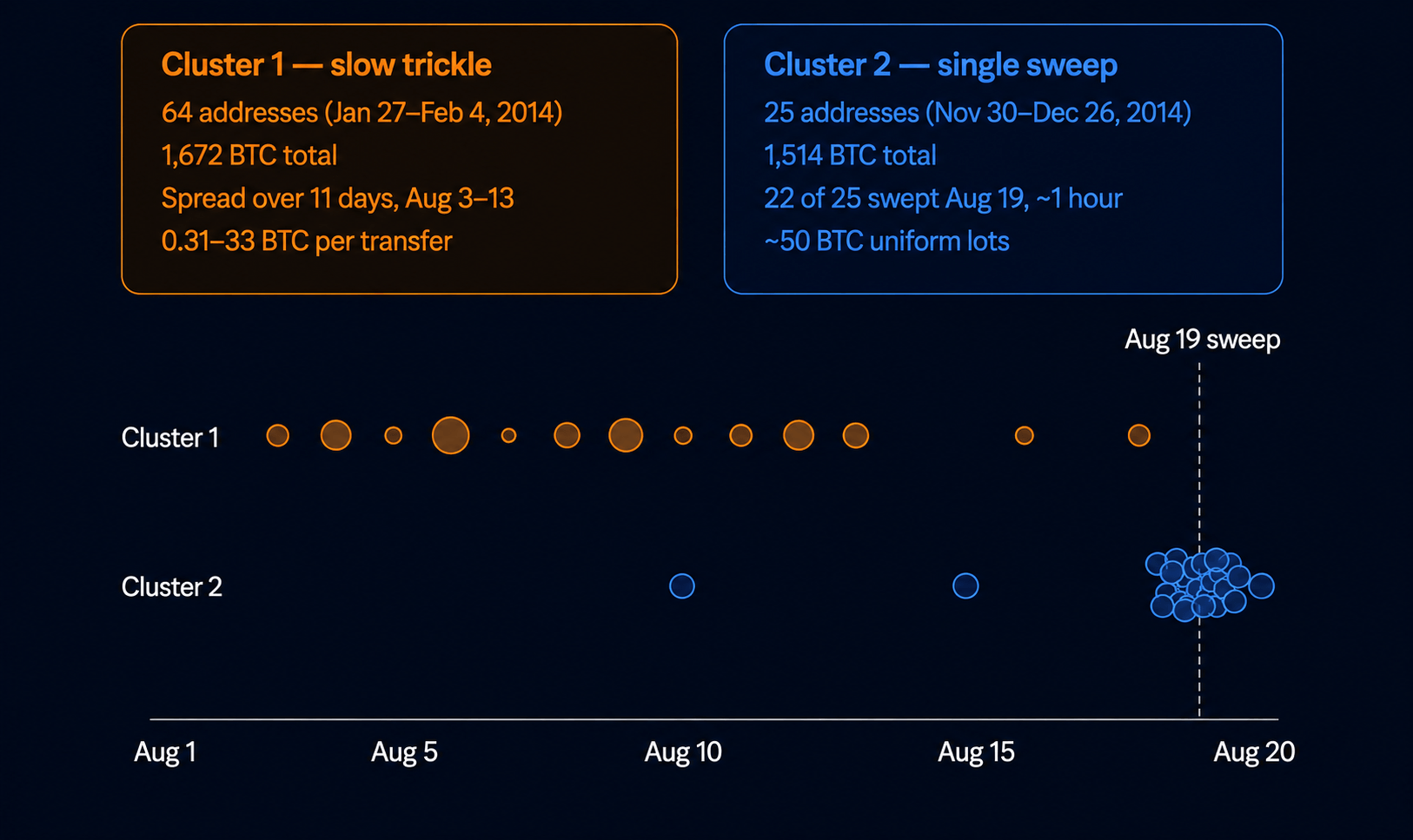
That degree of coordination makes several unrelated holders independently moving decade-old coins on the same afternoon improbable and instead points toward a single custodian or key holder executing a scripted batch sweep. The wallets appear to have been funded together in late 2014, potentially reflecting an exchange cold-storage reorganization, an escrow release, or a bulk paper-wallet distribution.
Bitcoin’s Sleeping Giants Don’t Leave Their Motives on the Blockchain
Certainly, the deeper story may extend beyond technical vulnerabilities to an erosion of confidence powerful enough to push even early adopters to reconsider passive custody. The coordinated batch of old bitcoin address movements suggests that larger holders may be proactively consolidating legacy holdings, increasingly treating aging keys as operational liabilities rather than digital trophies. The true motivations remain unknown, leaving the blockchain movements themselves as the only evidence capable of telling the story.

 Bitcoin
  Ethereum
  Tether
  BNB
BNB  XRP
XRP  USDC
USDC  Solana
  TRON
TRON  Lido Staked Ether
  Figure Heloc
  Zcash
Zcash  Hyperliquid
  Dogecoin
  USDS
USDS  Monero
  WhiteBIT Coin
  Wrapped stETH
  Chainlink
  LEO Token
  Wrapped Bitcoin
  Cardano
  Binance Bridged USDT (BNB Smart Chain)
  Stellar
  Wrapped Beacon ETH
  Rain
Rain  NEAR Protocol
  Bitcoin Cash
  Wrapped eETH
  Ethena USDe
  sUSDS
sUSDS  Dai
Dai  Litecoin
  Uniswap
  Canton
  Coinbase Wrapped BTC
  Avalanche
  USD1
USD1  Blockchain USD
  Sui
Sui  WETH
WETH  Gram (prev. Toncoin)
  Hedera
  Tether Gold
  USDT0
USDT0  Bitway
  Global Dollar
  Bittensor
  Shiba Inu
  PayPal USD
  Quant
Quant  Cronos
  Ethena Staked USDe
  Ethena
  OKB
OKB  Ripple USD
  Circle USYC
  Ondo US Dollar Yield
  Aave
Aave  BlackRock USD Institutional Digital Liquidity Fund
  Ondo
Ondo  Pump.fun
  Falcon USD
  Little Pepe
  Wrapped BOT
  syrupUSDC
  Aster
Aster  Polkadot
  MemeCore
  PAX Gold
  World Liberty Financial
  Worldcoin
  USDD
USDD  Mantle
  Spiko Amundi Overnight Swap Fund (EUR)
  Pepe
Pepe  Sky
Sky  Internet Computer
  Morpho
  United Stables
  HTX DAO
  Bitget Token
  Jupiter Perpetuals Liquidity Provider Token
  BFUSD
BFUSD  USDGO
USDGO  Ethereum Classic
  Arbitrum
  JUST
JUST  Jito Staked SOL
  Gate
Gate  Venice Token
  Kelp DAO Restaked ETH
  Jupiter
  KuCoin
  Binance-Peg WETH
  Rocket Pool ETH
  POL (ex-MATIC)
  Kaspa
Kaspa  Algorand
  Binance Bridged USDC (BNB Smart Chain)
  Blockchain Capital