
Buterin Says Ethereum’s Last ‘Normal’ Fork Is Planned for 2027
Roman Storm Targets Google and OpenAI Over DOJ Crypto Conviction
(Originally posted on : Bitcoin News )
Key Takeaways
- Storm says Google and OpenAI are liable for DPRK hackers using AI, exposing flawed DOJ logic.
- Storm argues his verdict sets a dangerous precedent, punishing neutral developers for user crimes.
- The proposed CLARITY Act offers developer protections, but low passage odds leave coders at risk.
Roman Storm Points at Google and OpenAI as North Korea’s Enablers
Roman Storm, founder of the anonymizing crypto protocol Tornado Cash, has called out Google and OpenAI as enablers of North Korea’s nuclear effort.
Storm, who was convicted of conspiracy to operate an unlicensed money transmitting business in August 2025, pointed out the flawed logic of the U.S. Department of Justice case against him.
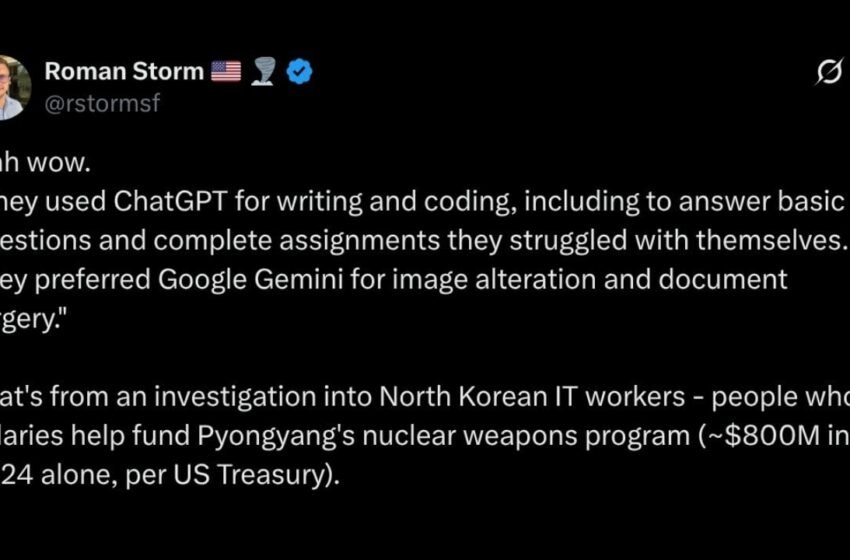
On social media, Storm remarked that a recent investigation into North Korean IT workers revealed the continued use of ChatGPT for writing and coding, and of Google Gemini for forgeries and image alteration by these threat actors.
Storm suggested that, following the same logic the DOJ applied against him, these two companies should be liable for the actions of these threat actors, as they provide these services and profit from their subscriptions.
“That’s exactly the theory behind USA v. Roman Storm: build a neutral tool, bad actors abuse it, and the developer gets prosecuted instead of the criminals,” he declared on social media.
“If that logic is absurd for Google and OpenAI – it’s absurd for Roman Storm.
You prosecute the criminal, not the toolmaker. Writing code is not a crime,” he stressed.
Storm and Tornado Cash verdict set a negative legal precedent in the U.S., as software developers can be held liable for code used for illicit purposes. He believes that large companies should also face similar consequences for the use of their products.
“So let’s be consistent: subpoena every Google and OpenAI employee. Dig through their text messages for any hint they knew their tools were used by DPRK. Indict them for 20 years in prison on IEEPA charges,” Storm concluded.
The Digital Asset Market Clarity Act, known as the CLARITY Act, introduces protections for software developers to be separated from possible illicit use of their protocols; nonetheless, even as there is a scheduled vote on the motion to proceed to its final consideration, the odds of it being passed continue to be low due to the current issues and the closeness of the midterm elections.



 Bitcoin
  Ethereum
  Tether
  BNB
BNB  XRP
XRP  USDC
USDC  Solana
  TRON
TRON  Lido Staked Ether
  Zcash
Zcash  Figure Heloc
  Hyperliquid
  Dogecoin
  Chainlink
  Monero
  Wrapped stETH
  WhiteBIT Coin
  USDS
USDS  Wrapped Bitcoin
  Cardano
  Rain
Rain  Binance Bridged USDT (BNB Smart Chain)
  Wrapped Beacon ETH
  LEO Token
  Stellar
  NEAR Protocol
  Bitcoin Cash
  Wrapped eETH
  Uniswap
  sUSDS
sUSDS  Litecoin
  Canton
  Sui
Sui  Ethena USDe
  Coinbase Wrapped BTC
  Avalanche
  Dai
Dai  Gram (prev. Toncoin)
  WETH
WETH  USD1
USD1  Hedera
  Bittensor
  USDT0
USDT0  Shiba Inu
  Cronos
  Bitway
  Global Dollar
  Quant
Quant  Ethena
  PayPal USD
  Ethena Staked USDe
  MemeCore
  Ondo
Ondo  Tether Gold
  OKB
OKB  Ripple USD
  Circle USYC
  Aave
Aave  Pump.fun
  BlackRock USD Institutional Digital Liquidity Fund
  Little Pepe
  Ondo US Dollar Yield
  Wrapped BOT
  syrupUSDC
  Mantle
  Polkadot
  Worldcoin
  Aster
Aster  Morpho
  Sky
Sky  PAX Gold
  World Liberty Financial
  Pepe
Pepe  Internet Computer
  USDD
USDD  Arbitrum
  HTX DAO
  Ethereum Classic
  Spiko Amundi Overnight Swap Fund (EUR)
  United Stables
  Jupiter Perpetuals Liquidity Provider Token
  Venice Token
  Bitget Token
  USDGO
USDGO  Falcon USD
  Kaspa
Kaspa  Jito Staked SOL
  BFUSD
BFUSD  POL (ex-MATIC)
  Kelp DAO Restaked ETH
  Gate
Gate  Jupiter
  Binance-Peg WETH
  Rocket Pool ETH
  Lighter
  Algorand
  Render
  Binance Bridged USDC (BNB Smart Chain)
  PancakeSwap
  JUST
JUST