


Trump Names Jay Clayton to Lead America’s Super Intelligence Force
Trump Names Jay Clayton to Lead America’s Super Intelligence Force
(Originally posted on : Bitcoin News )
Key Takeaways
- The force will engage consumers, religious groups, and AI companies.
- Clayton says the group has 120 days to assess risks and opportunities.
- An executive order establishes “Super Intelligence” as the federal government’s preferred AI terminology.
Jay Clayton and Three Officials Lead Federal AI Coordination
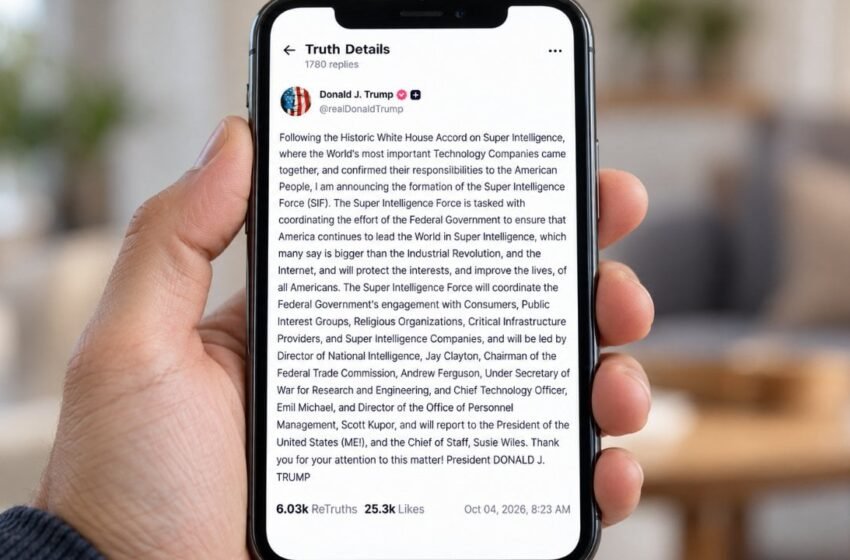
Consumers, public interest groups, and technology companies will engage with a new federal task force announced Oct. 4. President Donald Trump named Director of National Intelligence Jay Clayton among its four leaders when announcing the formation of the Super Intelligence Force on his social media platform Truth Social. The group follows a White House executive order establishing new federal terminology for artificial intelligence.
The president described a mission combining American technological leadership with protection of the public’s interests through coordinated government engagement. He said the effort would “ensure that America continues to lead the World in Super Intelligence” and “will protect the interests, and improve the lives, of all Americans.”
The other leaders are Federal Trade Commission Chairman Andrew Ferguson; Emil Michael, undersecretary of war for research and engineering and chief technology officer; and Office of Personnel Management Director Scott Kupor. Engagement also extends to religious organizations and critical infrastructure providers, including operators of essential services. The group reports to the president and White House Chief of Staff Susie Wiles.
Clayton told The Wall Street Journal that the group has 120 days to assess the technology’s risks and opportunities and determine Washington’s responsibilities. That deadline concerns its findings, separate from the terminology order’s 60-day requirement.
Clayton’s SEC Tenure Includes the Ripple Lawsuit
Clayton’s background includes leadership of the U.S. Securities and Exchange Commission (SEC), the regulator overseeing securities markets and investor protection. In April 2025, he was selected to serve as interim U.S. attorney for the Southern District of New York, before taking his current intelligence role.
The agency sued Ripple Labs and two executives on Dec. 22, 2020, one day before his departure as chairman. Its complaint alleged they raised more than $1.3 billion through unregistered investment contracts involving XRP. Both sides dismissed their appeals on Aug. 7, 2025, leaving a $125,035,150 civil penalty and a court order against future securities registration violations in effect.
The president has linked international competitiveness with American adoption of cryptocurrency and other digital assets, alongside his support for advanced computing. His broader technology agenda has framed both sectors as areas where U.S. leadership depends on encouraging innovation while keeping development and investment centered in the United States.
On July 6, he warned China would take the crypto lead if the U.S. stepped back, comparing the competitive stakes in digital assets with those surrounding other emerging technologies. The remarks reinforced his argument that technological leadership has become part of a wider contest over economic influence and the direction of future industries.
The Trump administration’s federal AI policy framework, released March 20, addressed child safeguards, data centers’ electricity costs, creators’ intellectual property, and worker retraining. The proposals sought national legislation and a uniform approach across the United States.
White House Order Establishes Super Intelligence Framework
A Sept. 29 White House executive order replaced federal AI terminology with “Super Intelligence” and “SI” in official communications and other nonstatutory documents, where permitted by law. It uses the existing legal definition of artificial intelligence and directs the White House science adviser to propose legislative language for a federal definition within 60 days.
The order frames the initiative around maintaining U.S. technological leadership as increasingly capable AI systems develop. It also directs federal agencies to incorporate the new terminology into relevant communications and policy materials where legally permitted.
The administration’s terminology change places the Super Intelligence Force within a broader federal effort to coordinate policy around advanced AI while emphasizing U.S. leadership in the technology.





 Bitcoin
  Ethereum
  Tether
  BNB
BNB  XRP
XRP  USDC
USDC  Solana
  TRON
TRON  Lido Staked Ether
  Figure Heloc
  Zcash
Zcash  Hyperliquid
  Dogecoin
  Monero
  Chainlink
  Wrapped stETH
  WhiteBIT Coin
  USDS
USDS  Wrapped Bitcoin
  Cardano
  LEO Token
  Binance Bridged USDT (BNB Smart Chain)
  Rain
Rain  Wrapped Beacon ETH
  Stellar
  NEAR Protocol
  Bitcoin Cash
  Wrapped eETH
  Uniswap
  sUSDS
sUSDS  Litecoin
  Canton
  Ethena USDe
  Avalanche
  Coinbase Wrapped BTC
  Sui
Sui  Dai
Dai  Blockchain USD
  Hedera
  WETH
WETH  USD1
USD1  Gram (prev. Toncoin)
  Quant
Quant  USDT0
USDT0  Shiba Inu
  Bittensor
  Cronos
  Tether Gold
  Ethena
  Bitway
  Global Dollar
  Ethena Staked USDe
  Pump.fun
  PayPal USD
  Aave
Aave  OKB
OKB  Ripple USD
  Circle USYC
  Ondo
Ondo  MemeCore
  Ondo US Dollar Yield
  Little Pepe
  BlackRock USD Institutional Digital Liquidity Fund
  Wrapped BOT
  syrupUSDC
  Worldcoin
  Mantle
  Polkadot
  Sky
Sky  Aster
Aster  Internet Computer
  Morpho
  Falcon USD
  PAX Gold
  Pepe
Pepe  World Liberty Financial
  USDD
USDD  Spiko Amundi Overnight Swap Fund (EUR)
  HTX DAO
  United Stables
  Ethereum Classic
  Jupiter Perpetuals Liquidity Provider Token
  Bitget Token
  Venice Token
  Arbitrum
  BFUSD
BFUSD  USDGO
USDGO  Jito Staked SOL
  Kaspa
Kaspa  Gate
Gate  Kelp DAO Restaked ETH
  Jupiter
  POL (ex-MATIC)
  Binance-Peg WETH
  Rocket Pool ETH
  Algorand
  JUST
JUST  KuCoin
  Binance Bridged USDC (BNB Smart Chain)
  Render