


UK Sanctions Crypto Exchanges Over Suspected Russia-Linked Evasion
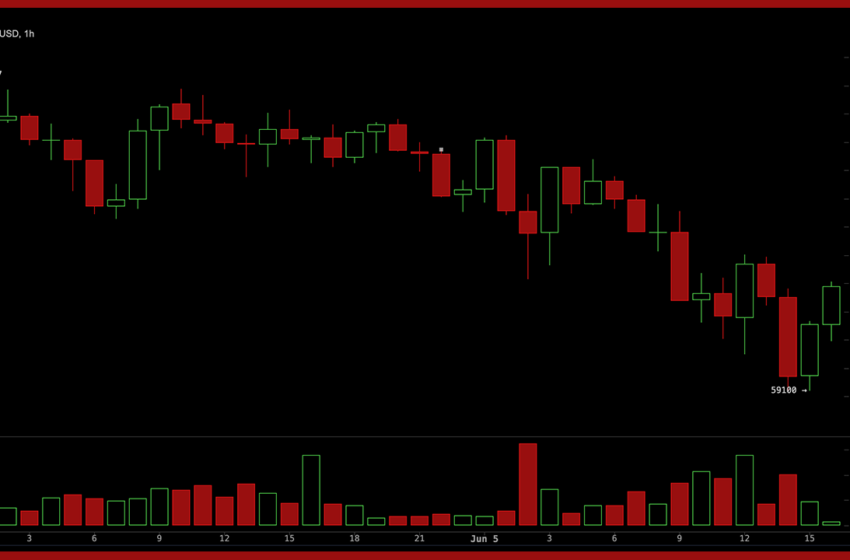
Why Is Bitcoin Crashing? Worst Week of 2026, $59,100 Low, and More Than Half of All BTC Now in the Red
(Originally posted on : Bitcoin News )
Key Takeaways
- Bitcoin hit a 2026 intraday low of $59,100 on June 5, falling 19.3% in 7 days and 26.8% over 30 days.
- Coinglass data shows $1.75 billion in liquidations in 24 hours, with 351,233 traders wiped out across crypto markets.
- More than half of all BTC now sits at an unrealized loss, a signal that has marked every major bear market bottom in bitcoin’s history.
Bitcoin Falls 19% in 7 Days and Touches $59,100
The move extended a sharp selloff that has taken bitcoin down 19.3% in seven days, 22.2% in the past fortnight, and 26.8% over the past month. Over the past year, the price has dropped 42.3%. The latest range of $59,000 to $60,000 puts bitcoin well below the $71,000 level it traded at just four days earlier, on June 1.
Liquidations Flood the Market
Liquidation data from Coinglass shows $1.75 billion in total crypto liquidations in the past day, with long positions accounting for $1.45 billion of that figure. Bitcoin alone absorbed $560.72 million in liquidations ($448M in longs), followed by ethereum at $473.02 million ($408M in longs). The largest single liquidation order was a BTCUSDT position on Binance worth $13.31 million. At 4 p.m. EDT, over the past four hours, $411.68 million was liquidated, with longs representing $329.21 million of that total.
Elevated leverage in perpetual futures markets left traders exposed as price broke through key support levels. The cascade that followed is a well-documented pattern in crypto corrections: stops trigger, prices fall further, more stops trigger.
ETF Outflows and the Strategy Sale
Institutional pressure has been a central driver. U.S. spot bitcoin exchange-traded funds (ETFs) saw estimated net outflows of $2.8 billion to $3.5 billion over 10 to 11 consecutive trading sessions in late May and early June, with one week alone recording approximately $3.4 billion in redemptions, the largest single-week outflow since ETF products launched in early 2024. Blackrock’s IBIT was among the products seeing significant redemptions.
Another psychological hit came from Strategy, formerly Microstrategy. The company disclosed in a June 1 U.S. Securities and Exchange Commission (SEC) filing that it sold 32 BTC between May 26 and May 31 at an average price of approximately $77,135 per coin, generating roughly $2.5 million in proceeds. The sale, the company’s first net bitcoin disposal since 2022, was used to fund distributions on its STRC perpetual preferred stock. Strategy still holds more than 843,700 BTC at an average cost basis of approximately $75,699.
The economic impact of 32 coins is minimal. The narrative impact was not. Strategy’s brand has been built in large part on a no-sell commitment, and the filing shattered that image for a portion of the market. Retail selling followed. Many think that now that the ice has been broken, more sales could follow.
200-Week Moving Average Breaks
Bitcoin has now fallen below its 200-week moving average for the first time since June 2022, exactly four years ago. That level has historically served as a long-term support floor and a marker for cycle lows.
Onchain data adds weight to the moment: more than half of all bitcoin in circulation is now held at an unrealized loss. That reading has coincided with every major bear market bottom in bitcoin’s history. Whether it signals a floor or marks the beginning of a deeper decline depends on what comes next for inflows, macro conditions, and price action at current support levels.
The social media account and Cryptoquant contributor, Darkfrost, posting on X, flagged that bitcoin transaction volume is approaching an all-time high on a 30-day moving average basis, even as the correction deepens, calling it “one of the most significant” changes of hands in bitcoin’s history.
The average monthly transaction count has reached approximately 640,000, a level only matched once before, in September 2024 during that year’s correction, when 666,000 transactions were recorded. Darkfrost noted the timing is unusual: in prior cycles, rising transaction counts typically coincided with bullish phases or market tops, not accelerating drawdowns.
With June already down roughly 19%, Darkfrost framed the activity as a capitulation event rather than a bullish signal, writing:
“This is more of a capitulation episode and a significant change of hands.”
Fear Dominates Sentiment
The Crypto Fear and Greed Index dropped to a reading between 11 and 15 during the first week of June, placing it firmly in Extreme Fear territory. As of today, the Crypto Fear and Greed Index hosted on alternative.me notes the score is currently a 12. Social media commentary has been dominated by references to the selloff, criticism of leveraged positioning, and questions about MSTR’s strategic credibility.
According to Google Trends data, the search term “ bitcoin” reached a worldwide peak score of 100 over the past week.
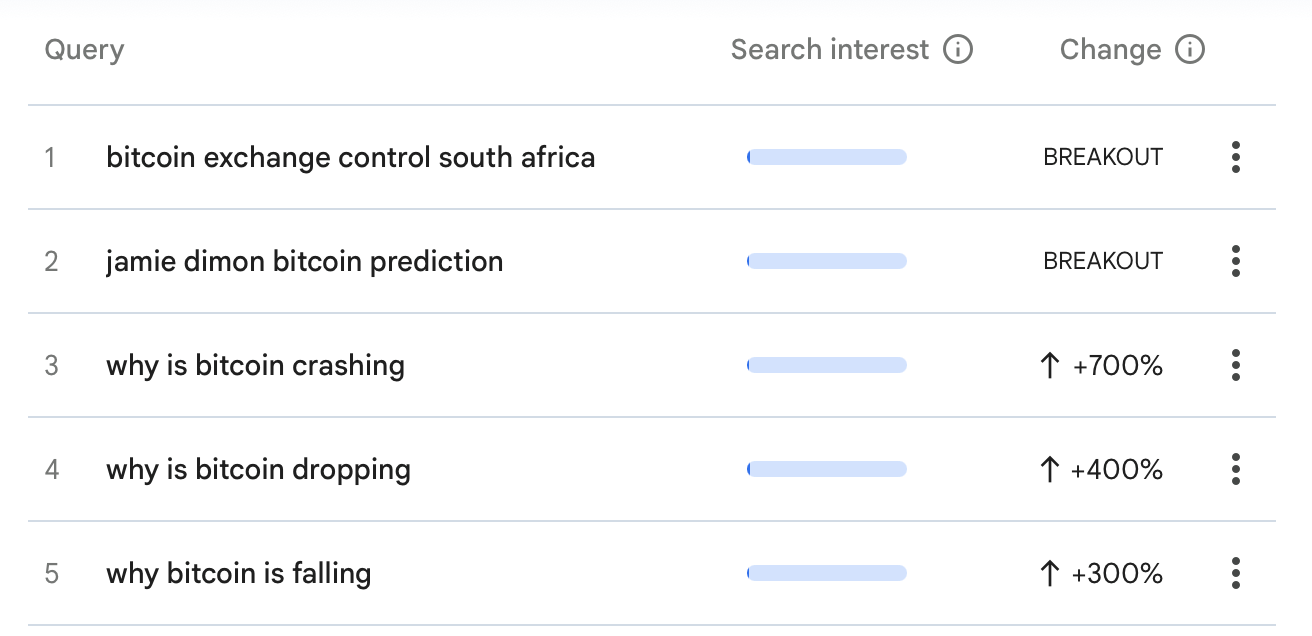
Such a reading signals a pronounced rise in public curiosity. The underlying data helps explain the phenomenon, as related searches are overwhelmingly focused on price action. Leading query trends tied to the term “ bitcoin” include “why is bitcoin crashing,” “why is bitcoin dropping,” and “why bitcoin is falling.”
Macro Backdrop
Broader conditions have not helped. Escalating geopolitical tensions involving the U.S. and Iran have pushed oil prices higher, adding to inflation concerns and complicating Federal Reserve rate policy. Expected rate cuts have been delayed, and some Fed officials have declined to rule out further hikes. That environment has pressured risk assets broadly, and bitcoin has not been immune.
AI Rotation Might be Pulling Capital Away From Bitcoin
Capital rotation into artificial intelligence (AI) equities has added another layer of selling pressure. Institutional and speculative investors have been moving risk capital out of bitcoin and into AI-related stocks, semiconductor plays, and data-center infrastructure, where near-term earnings growth and clearer catalysts have made the opportunity cost of holding BTC feel too high.
Many observers have flagged the dynamic directly, noting investors are favoring AI stocks and upcoming tech IPOs over crypto and warning of a potentially choppy summer ahead for bitcoin. Strategy Chairman Michael Saylor addressed the shift in a June 4 post on X. He wrote that capital markets are funding the AI buildout at roughly $400 billion over six months, and that the approximately $4 billion in bitcoin ETF outflows since May 14 reflect a capital rotation rather than any impairment of bitcoin’s fundamentals.
Saylor framed the volatility as an opportunity. Many long-term holders share that view, pointing to prior cycles where capital rotated back into bitcoin once AI enthusiasm cooled or macro conditions improved.
What Analysts Are Watching
Analysts are pointing to $60,000 as a critical support level. A consistent and sustained break below that opens the door to tests around $58,000. Some have noted that liquidity clustering near $53,000 makes that level a potential magnet if selling continues, with the possibility of a wick below $50,000 if that zone is reached.
On the other side, oversold RSI readings on daily charts, historically rare levels around 17 to 18, have preceded strong recoveries in prior cycles. A reversal in ETF flows, any de-escalation in geopolitical tensions, or clarity on Federal Reserve policy could provide the catalyst for a relief rally.
ETFs still hold substantial lifetime inflows despite the recent streak of redemptions. Long-term holders have not shown broad capitulation. The data supports caution, not certainty about direction. By 4:30 p.m. EDT on Friday, bitcoin was coasting along at $61,120 per coin after gaining a percentage point over the last hour.
Until then, everyone is holding their breath.




 Bitcoin
  Ethereum
  Tether
  BNB
BNB  XRP
XRP  USDC
USDC  Solana
  TRON
TRON  Lido Staked Ether
  Figure Heloc
  Zcash
Zcash  Hyperliquid
  Dogecoin
  Monero
  USDS
USDS  WhiteBIT Coin
  Wrapped stETH
  Chainlink
  Cardano
  Wrapped Bitcoin
  LEO Token
  Binance Bridged USDT (BNB Smart Chain)
  Rain
Rain  Wrapped Beacon ETH
  Stellar
  NEAR Protocol
  Bitcoin Cash
  Wrapped eETH
  Litecoin
  sUSDS
sUSDS  Ethena USDe
  Canton
  Uniswap
  Avalanche
  Coinbase Wrapped BTC
  Dai
Dai  Sui
Sui  Blockchain USD
  USD1
USD1  WETH
WETH  Hedera
  Gram (prev. Toncoin)
  Bitway
  USDT0
USDT0  Quant
Quant  Tether Gold
  Global Dollar
  Shiba Inu
  Bittensor
  Cronos
  PayPal USD
  Ethena Staked USDe
  Ethena
  OKB
OKB  Pump.fun
  Aave
Aave  Ripple USD
  MemeCore
  Circle USYC
  Ondo US Dollar Yield
  Ondo
Ondo  Little Pepe
  BlackRock USD Institutional Digital Liquidity Fund
  Wrapped BOT
  syrupUSDC
  Polkadot
  Aster
Aster  Worldcoin
  PAX Gold
  Mantle
  Falcon USD
  Sky
Sky  World Liberty Financial
  Internet Computer
  Morpho
  Pepe
Pepe  Spiko Amundi Overnight Swap Fund (EUR)
  USDD
USDD  United Stables
  HTX DAO
  Bitget Token
  Jupiter Perpetuals Liquidity Provider Token
  BFUSD
BFUSD  USDGO
USDGO  Ethereum Classic
  Arbitrum
  Jupiter
  Jito Staked SOL
  JUST
JUST  Gate
Gate  Kelp DAO Restaked ETH
  Venice Token
  Kaspa
Kaspa  Binance-Peg WETH
  Rocket Pool ETH
  Algorand
  KuCoin
  POL (ex-MATIC)
  Binance Bridged USDC (BNB Smart Chain)
  Cosmos Hub